

NanoConjugates
We use the convincing properties of single domain antibodies (also referred to as nanobodies) to optimise specificity, sensitivity, signal intensity and stability properties of in vitro diagnostic assays (IVD).
The variable domains of heavy chain only antibodies, are by now an established alternative to conventional antibodies for various research questions. Their small size and excellent binding properties are of great advantage for many approaches. Moreover, there are first concepts for medical applications. Nonetheless, the field of medical in vitro diagnosis of diseases is so far still largely unexploited. This is our starting point.
The first reagents we offer are NanoConjugates, which are designed to detect human IgG, IgM or IgA and surpass conventional animal derived antibody conjugates not only in binding characteristics, but also in reproducibility and price. They are based on a nanobody module directed towards human immunoglobulins and linked to a reporter protein labelled with either acridinium or horseradish peroxidase for colorimetric or chemiluminescent detection.
Their suitability for diagnostic immunoassays with blood samples is proven and furthermore, we provide an experimental dataset, which characterises their binding properties and confirms their performance for different setups in research and medical diagnosis.
Key characteristics of NanoConjugates: Specific, sensitive, intensive signal, stable, reproducible, cost effective, free from animal testing.
Background
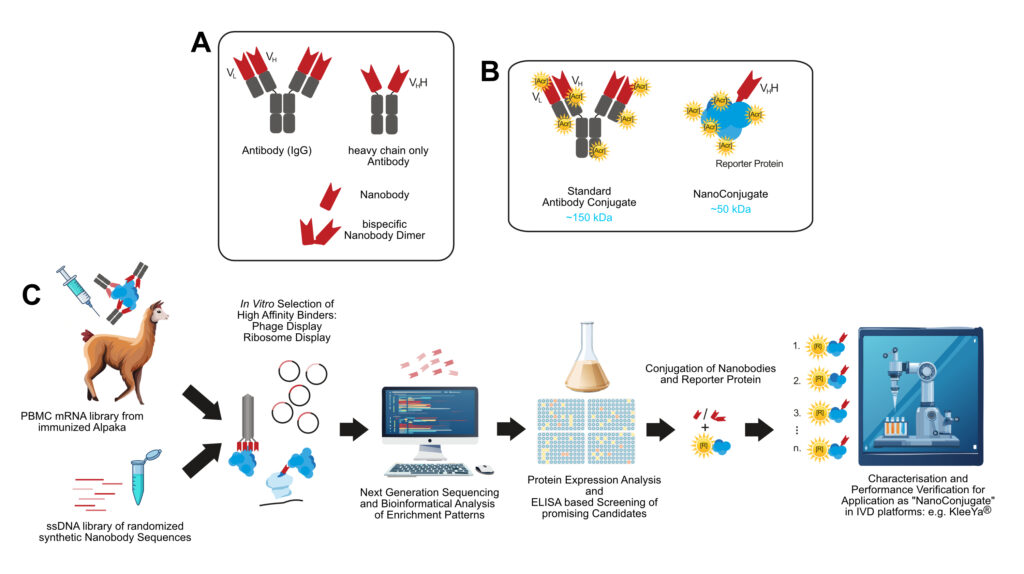
Our NanoConjugates are based on the variable domain of heavy chain only antibodies, linked to a reporter protein. Their small size, defined labelling and reproducibility cause convincing benefits over standard antibody conjugates (Fig. A and B, exemplary for acridinylated variants).
NanoConjugates originate from a multi-level in house selection process starting with cDNA libraries derived from immunized alpaka PBMC cells or a random single stranded synthetic DNA library coding for the variable domain of heavy chain only antibodies. The processing includes multiple rounds of in vitro selection or more precisely phage and ribosome display for enrichment of putative binders to the adressed target antibodies in combination with Next Generation Sequencing as well as bioinformatical analysis of enrichment patterns. Promising candidate pools are screened for their ability to bind human serum antibodies in a diagnostic ELISA assay and the best performing ones are further characterised by protein expression analysis. As reporter module, we link a discrete protein module with either acridinium or horseradish peroxidase. The final constructs are validated regarding their applicability in IVD platforms, such as LineAssay or bead based automated CLIA (Fig. C)
Performance
The performance of our NanoConjugates is confirmed by various assays. Some of them are illustrated here.
I. Signal Intensity and Discrimination
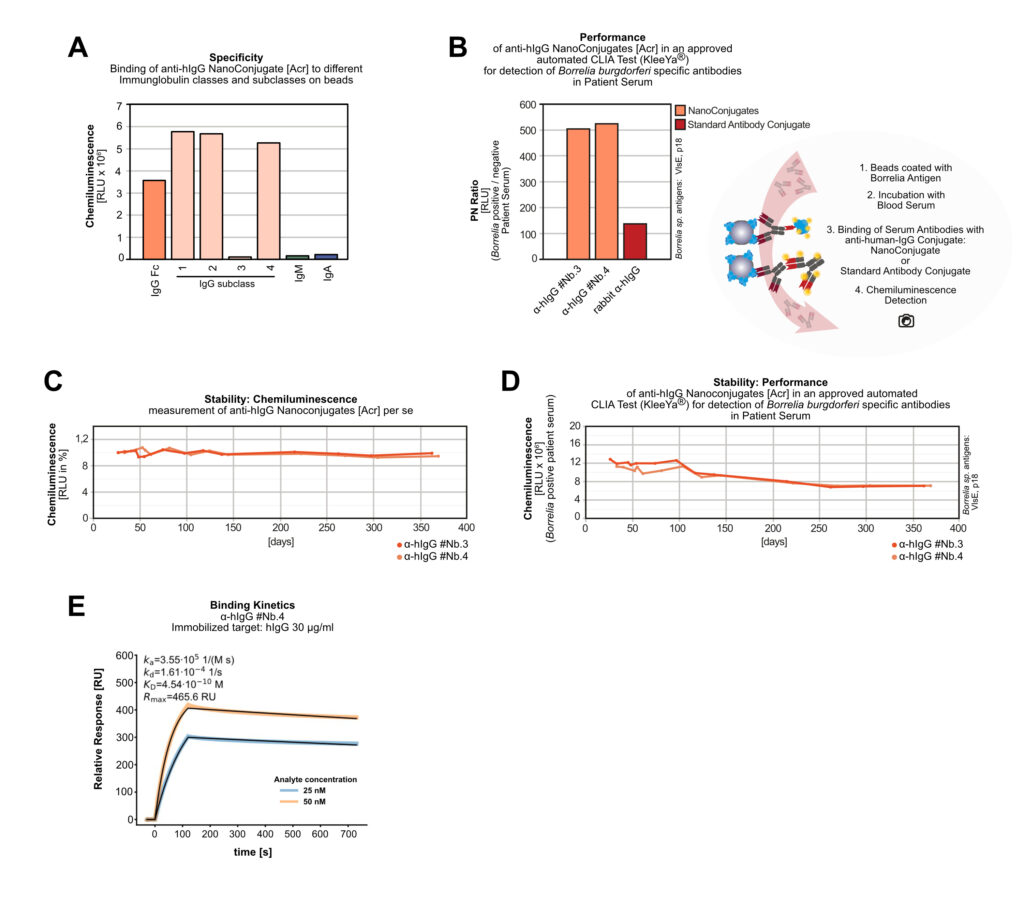
NanoConjugates possess a high antibody class specificity, illustrated for example by the following CLIA assay: beads were coated with different Antibody Classes and Subclasses and incubated with Acridinium labelled NanoConjugate. The subsequent luminescence measurement reveals high signals and target specificity (Fig. A).
Moreover, NanoConjugates outperform standard antibody conjugates derived from rabbit in diagnostic assays, as shown in the following CLIA setup: Beads coated with Borrelia burgdorferi derived antigens were incubated with blood serum from a patient with known infection and from a healthy person. Antigen specific antibodies were detected with an acridinium labelled standard conjugate or a NanoConjugate. Signal discrimination between positive and negative blood sample (P/N ratio) by the NanoConjugate is multiple times higher than by the standard antibody conjugate (Fig. B).
II. Stability
NanoConjugates are proven to be stable for at least 350 days at 4°C. CLIA assays show the signal intensity of Acridinium labelled NanoConjugates per se as well as its performance in a diagnostic CLIA test setup with Borrelia burgdorferi antigen loaded beads and blood serum from an infected patient over time (Fig. C and D).
III. Binding kinetics
Moreover, our NanoConjugates exhibit high target binding affinities, confirmed by Surface Plasmon Resonance Measurements (E).
Cross Reactivity
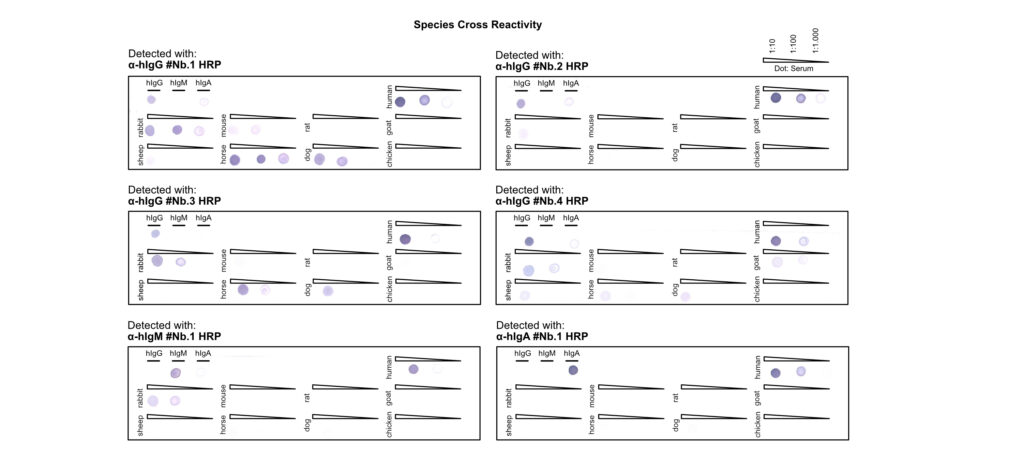
Select a NanoConjugate with narrow cross reactivity according to your specific requirements or select one to detect antibodies from a broader range of species.
Further Characterisation
For more detailed Information regarding our individual NanoConjugates, please have a look at ->Purchase.